
Homerun
August 10, 2026
-
4 min read
The Training Investment Nobody Reinforces

Every sales engineering leader knows what a methodology training program costs. There are the fees and materials, the travel, and the selling hours a team gives up while sitting in a room to learn. What gets far less attention is how quickly that investment starts to leak away once everyone goes back to their calendars.
Research on this challenge builds on studies by Hermann Ebbinghaus and is supported by a 2015 replication [1], which shows that without reinforcement, people forget most of what they learn within about a week, retaining as little as 10 to 20 per cent. Additionally, decades of research on how training transfers to the job consistently finds that only a minority of what people learn in a program changes how they work unless it is reinforced afterwards [2].
So extrapolating that, a team that spends $100,000 sending its sales engineers through a methodology program could see as much as $80,000 to $90,000 of that investment fade within the first week or two. The training itself was good, but there was nothing to reinforce it once the workshops ended and real calls resumed.
Why coaching breaks down at scale
Coaching is an obvious solution here, and if you ask most frontline sales engineering managers whether they'd like to sit in on every call their team runs and give direct feedback afterwards, the answer is almost always yes. They want their people to get better and help them apply what they’ve learnt, but they just don't have the hours. A manager with six or eight direct reports, each running discovery calls, demos, and POC conversations multiple times a week, cannot realistically listen to all of it and still do the rest of the job.
This leads to coaching being delivered on an ad hoc basis, with one or two calls this week and possibly none the next. Feedback also depends on what stood out to them in the moment, rather than a consistent standard applied each time.
That gap is exactly what Homerun's coaching is built to close.
What if every call could be coached?
Every call transcript already flows into Homerun, so Coach AI (Homerun’s AI/agentic layer) can analyze it to surface what a sales engineer actually needs to know and act on. This includes business objectives, product gaps, new buyers, follow-up items, and relevant CRM fields, all filled in automatically, with a human-in-the-loop to ensure any changes are approved first. Coach AI also generates a call summary, and that's where it parts ways with generic call recorders. Tools like Gong, Zoom, or Teams can tell you what was said, but they're not built to listen the way a sales engineer listens, so what they flag as important rarely matches what an SE needs from a summary. Coach AI is built around what actually matters to a sales engineer to move a deal forward to close.
Call coaching uses that same transcript foundation, but asks a different question: how did the sales engineer actually perform? SEs can review the transcript from a call they just ran, but more importantly, they get automatic feedback against sales engineering best practices for discovery, demo delivery, or any other type of call. This covers presentation style, structure, clarity, engagement, objection handling, discovery questions, and follow-on questions that could have gone deeper. It's automated, included in Homerun at no extra cost, and doesn't need a manager to sit in on the call or listen to the recording.
When methodology matters
Training in general presales best practices is a great start, but high-performing teams often invest in a specific, named methodology, and that investment deserves feedback that aligns directly with the methodology rather than a generic rubric.
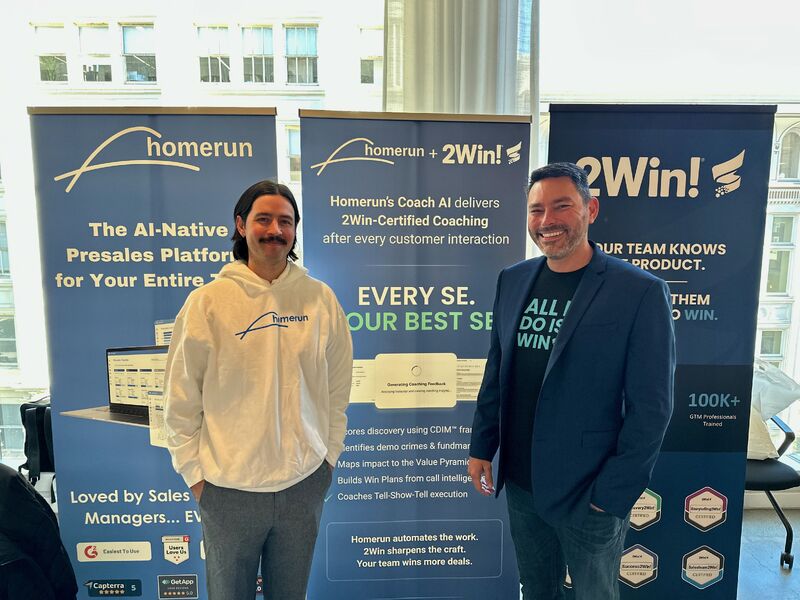
That's the thinking behind Homerun's partnership with 2Win!, a well-known sales methodology training organization behind programs like Demo2Win and Discovery2Win. Teams that have completed that training can now receive coaching in Homerun modelled on 2Win's frameworks and built with 2Win directly on the underlying AI agents. The feedback reads as a 2Win consultant would assess the call, covering whether there was a strong opening story (sometimes called a limbic opening), whether the call followed a clear visual roadmap, and whether the sales engineer executed the tell-show-tell structure the methodology is known for. It closes with top strengths, specific areas for improvement, and a summary note, in the same shape as a live 2Win review would take.
The result is coaching that's consistent with the standard a team has already paid to learn, applied to every call rather than the occasional one someone happens to review.
Bring your own prompt
Not every team's methodology comes from an external training partner. Some have developed their own best practices internally over years, with their own language and priorities. For those teams, Homerun can incorporate their existing coaching criteria directly, rather than asking anyone to switch to an off-the-shelf standard. The goal is to ensure that whatever methodology a team is following is applied consistently across every call and specific to their organization, technical sales motion, and sales engineering playbook.
From feedback to action
Feedback that only describes what happened is just a summary. The distinction with coaching is articulating what a sales engineer is supposed to do differently on the next call. Homerun's coaching output includes concrete next actions alongside the overall assessment, such as tightening a specific ask or being more precise about next steps, so a sales engineer walks away with something they can apply immediately.
Where it's heading
This is an area Homerun continues to build on, focusing on pattern tracking over time in addition to call-by-call feedback. This builds a clearer picture of an individual's trends, providing a rollup view for managers who face the same time constraints on how their team is doing overall.
The training investment has usually already been made, whether that's a third-party program or best practices built in-house over time. What's always been missing is a way to ensure that investment shows up consistently once people are back on real calls, without requiring a manager to catch it. That's the gap Homerun closes, and it does it inside a platform built precisely for the sales engineering teams that it supports.
If you’d like to learn more, reach out for a demo >
Latest articles




.avif)

.avif)





Blog
POC Best Practices: Evaluation Plans – The Key to Great POCs and POVs
December 7, 2022
-
4 min read



















Blog
How to Get Marketing to Find Deals that Are Amazing ‘Technical Fits’
November 10, 2021
-
4 min read








Ready to make presales your unfair advantage?
One workspace, one team. Give everyone the clarity to work together, move faster, and win more.